
Have you ever listened to a favorite song through two different speakers and wondered why one sounds rich and detailed while the other feels flat or unpleasant? The recording hasn’t changed, but the way different frequencies are reproduced can completely alter the listening experience. Sometimes the bass overwhelms the vocals, while other times sharp high
Have you ever listened to a favorite song through two different speakers and wondered why one sounds rich and detailed while the other feels flat or unpleasant? The recording hasn’t changed, but the way different frequencies are reproduced can completely alter the listening experience. Sometimes the bass overwhelms the vocals, while other times sharp high notes make even an excellent recording difficult to enjoy.
A Quad Equalizer provides a practical way to manage these differences. In audio applications, the term commonly describes an equalizer with four adjustable frequency bands, allowing users to control different parts of the sound spectrum independently. Rather than changing the overall volume, it adjusts how strongly particular frequencies are heard.
The term also has other technical meanings, including four-channel audio processors and specialized electronic components used to improve high-speed digital signals. Understanding these distinctions helps explain why Quad Equalizers appear in discussions about music production, car audio, professional sound systems, and electronic engineering.
Why Some Sounds Need More Attention Than Others
Every sound contains frequencies that contribute to its recognizable character. Low frequencies create weight and depth, middle frequencies carry much of the detail in voices and instruments, and higher frequencies contribute brightness and definition.
When these elements are balanced, music can feel natural and enjoyable. When certain frequencies dominate, the result may become muddy, thin, harsh, or tiring.
An equalizer changes the level of selected frequency regions without necessarily affecting every part of the recording equally.
For example, reducing excessive low frequencies can make speech easier to understand when heavy bass is masking the voice. A careful adjustment to the upper frequencies may soften unpleasant sharpness.
A Quad Equalizer offers four sections for making such changes. This provides more flexibility than basic bass and treble controls while remaining relatively straightforward to operate.
However, equalization cannot repair every audio problem. Distortion caused by clipping, poor recordings, or damaged speakers may remain noticeable regardless of frequency adjustments.
What the Word Quad Actually Tells You
The word quad means four, but its precise meaning depends on the equipment being discussed.
In a typical four-band audio equalizer, it refers to four controllable frequency sections. Each section allows the user to raise or lower a particular region of sound.
However, a professional four-channel equalizer may process four independent audio signals, with each channel containing multiple frequency controls.
In digital electronics, Quad Equalizer can describe an integrated circuit that equalizes four high-speed data channels.
These products perform different jobs despite sharing similar terminology.
If a device appears in a music mixer, audio software, or car stereo specification, it probably relates to sound processing. If the term appears in a semiconductor datasheet discussing DisplayPort or PCI Express, it refers to digital signal conditioning instead.
The technical context is therefore essential when identifying the intended equipment.
Four Sound Regions That Shape What Your Ears Hear
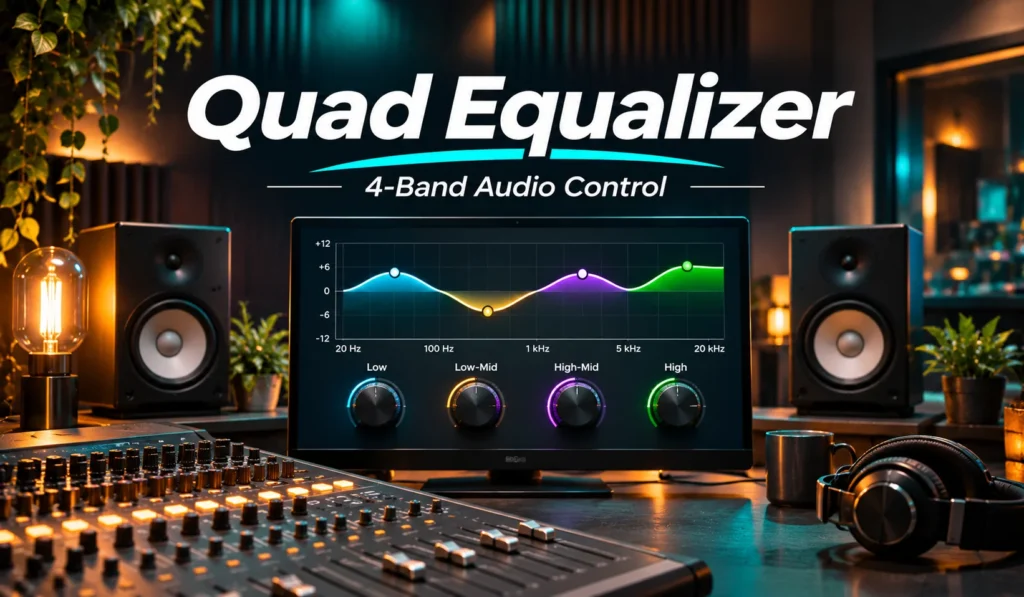
A conventional four-band audio equalizer divides its controls into low, low-mid, high-mid, and high-frequency regions.
These ranges are not universally fixed. Manufacturers may select different center frequencies, adjustable ranges, or filter designs.
The low-frequency band controls the deeper elements of sound, including bass instruments, kick drums, and low-frequency energy. Excessive boosting can create a heavy or boomy result, particularly with speakers that cannot reproduce deep bass cleanly.
The low-midrange band influences warmth and body. Vocals, guitars, keyboards, and many instruments contain important energy in this region. Too much low-midrange energy may create muddiness, while excessive reduction can make recordings sound weak.
The high-midrange band contributes presence, articulation, and definition. Adjustments here can make voices easier to distinguish, although aggressive boosting may introduce harshness.
The high-frequency band affects brightness, cymbal detail, and the sense of air in a recording. Carefully chosen adjustments can improve perceived clarity, but excessive treble may exaggerate hiss or make listening uncomfortable.
The advantage of four separate bands is that users can influence these characteristics without changing the entire frequency spectrum at once.
The Three Controls That Determine How Equalization Behaves
Not every Quad Equalizer provides the same controls.
Basic models may offer fixed frequency bands with simple boost and cut adjustments. More advanced parametric equalizers allow users to select the frequency being modified and control the width of the affected region.
Three parameters are particularly important.
Frequency identifies the part of the spectrum being adjusted. Lower settings affect deeper sounds, while higher settings influence brighter components.
Gain determines how much a selected frequency region is increased or reduced. It is commonly measured in decibels.
Q factor controls the width of the affected frequency region in many parametric equalizers. A higher Q generally produces a narrower adjustment, while a lower Q affects a broader range.
Understanding these controls makes it easier to correct specific problems rather than adjusting settings randomly.
For beginners, starting with small gain changes is generally more useful than immediately applying extreme boosts.
Why Turning Everything Up Rarely Produces Better Sound
A common equalization mistake is increasing several frequency bands simultaneously.
Although this can make audio initially seem more powerful, it may also increase signal levels enough to create clipping or unwanted distortion.
Large boosts can exaggerate weaknesses in speakers or headphones and reduce the natural balance of a recording.
A more controlled approach involves listening for the frequency region causing the problem.
If music sounds muddy, reducing excessive low-midrange energy may be more effective than boosting treble aggressively.
If vocals seem buried, lowering competing frequencies can sometimes improve clarity without substantially increasing overall loudness.
It is also important to compare adjusted sound with the original at similar perceived volume levels.
Louder audio can seem more impressive even when the tonal balance is not actually better.
How a Quad Equalizer Fits Into a Car Audio System
Car interiors create difficult listening conditions.
Speakers are positioned at different distances from passengers, interior surfaces reflect sound, and road noise can mask important frequencies.
A four-band equalizer can help adjust tonal balance to suit the vehicle and listening preferences.
For example, excessive bass may become tiring during longer journeys, while insufficient midrange detail can make podcasts difficult to understand.
However, equalization cannot fully compensate for poor speaker placement, damaged components, or acoustical limitations.
Some car audio systems include their own built-in equalizers, making additional external equipment unnecessary.
Before purchasing a separate unit, users should check whether it is compatible with the existing head unit, amplifier, and signal connections.
Professional installation may be appropriate when modifications involve vehicle wiring.
The Difference Between Studio Mixing and Casual Listening
Music producers and recording engineers use equalizers for purposes that differ from ordinary listening adjustments.
During mixing, equalization helps individual instruments occupy suitable areas of the frequency spectrum.
A recording may contain several sounds competing within the same range. Careful adjustments can improve separation and make the overall arrangement easier to hear.
For example, reducing unnecessary low frequencies in an instrument that does not require deep bass may leave more space for the kick drum and bass guitar.
A four-band parametric equalizer can be sufficient for broad tonal adjustments and many common mixing tasks.
More complex recordings may require additional bands, dynamic equalization, or other processing tools.
The number of bands alone does not determine audio quality. Filter design, processing accuracy, and the engineer’s decisions also matter.
When Four Bands Are Enough and When They Aren’t
A Quad Equalizer offers a useful balance between simplicity and control.
For everyday music listening, podcast adjustments, or basic live sound, four well-chosen bands may provide everything needed.
More demanding tasks can require greater precision.
Room correction, feedback control, and detailed mastering may benefit from equalizers offering additional bands or specialized filters.
A ten-band graphic equalizer provides more frequency adjustment points, while a thirty-one-band unit offers narrower control across the spectrum.
However, additional controls also create more opportunities for excessive or unnecessary adjustments.
The right choice depends on the problem being solved.
A listener seeking slightly warmer music does not necessarily need the same equipment as a professional attempting to control feedback in a large venue.
Quad Equalizer Has Another Meaning in Digital Electronics
Outside audio processing, the term appears in high-speed electronic circuits.
A digital Quad Equalizer is typically a four-channel signal-conditioning device designed to compensate for signal degradation along cables or printed circuit board traces.
High-speed electrical signals can lose strength at certain frequencies as they travel through a transmission path. This may make it more difficult for receiving equipment to distinguish the intended data reliably.
Equalization helps compensate for these losses.
For example, specialized integrated circuits have been developed for interfaces such as DisplayPort and PCI Express.
Products including the Texas Instruments DS32EV400 and Analog Devices MAX14950 demonstrate this type of technology.
These components are fundamentally different from musical equalizers. They work with high-speed data signals rather than adjusting bass, vocals, or treble.
Engineers selecting such components must consider data rates, signal characteristics, electrical requirements, and current manufacturer support.
A Simple Method for Finding a More Natural Sound
Equalization becomes easier when adjustments are made with a specific listening goal.
Begin with the controls in their neutral positions, usually marked as 0 dB.
Play a recording you know well and listen carefully before changing anything.
If the bass dominates, make a small reduction in the low-frequency region. If voices seem overly thick or unclear, experiment gently with the low-midrange.
When sound becomes piercing or tiring, investigate the upper-midrange or treble rather than immediately reducing the entire volume.
After each adjustment, listen to the overall balance.
Avoid judging the result from only a few seconds of audio. A setting that improves one part of a song might make another section less natural.
The aim is not to create the most dramatic sound possible but to achieve a balance that remains comfortable and clear.
Common Questions About Quad Equalizer
What is a Quad Equalizer?
A Quad Equalizer commonly refers to an audio equalizer with four adjustable frequency bands. In other contexts, it may describe four-channel audio equipment or a four-channel digital signal-conditioning component.
Is a Quad Equalizer better than a three-band equalizer?
It provides an additional frequency section, which can offer more control. However, the quality of the result depends on the equipment and how the adjustments are used.
Can a Quad Equalizer improve bass?
Yes. It can increase or reduce selected low frequencies, although the result is limited by the capabilities of the speakers and audio system.
Is it suitable for gaming?
A four-band audio equalizer can help adjust sound balance in games, including reducing excessive bass or changing the prominence of certain midrange details. It cannot guarantee a competitive advantage.
Does a Quad Equalizer increase volume?
Boosting frequencies may increase signal level and perceived loudness, but equalization is intended primarily for tonal control rather than replacing a volume adjustment.
Can it remove background noise?
It may reduce noise concentrated in certain frequency ranges, but it cannot reliably separate all unwanted noise from speech or music. Dedicated noise-reduction tools may be more suitable.
Are all Quad Equalizers the same?
No. Designs differ in the number of processed channels, filter types, adjustment ranges, frequency controls, and intended applications.
The Real Advantage Comes From Knowing What Not to Change
A Quad Equalizer offers a practical way to take greater control of sound without requiring an unusually complicated setup.
Its four-band approach is flexible enough for everyday listening, useful in many recording situations, and straightforward enough for beginners to understand.
At the same time, the term has several technical meanings, making it important to identify whether a particular device is intended for audio adjustment, multichannel processing, or high-speed electronic signal equalization.
For music and entertainment, the best results usually come from restrained adjustments guided by careful listening. More bass does not always mean better sound, and stronger treble does not automatically produce greater clarity.
For More Visits: TR Electro: Understanding Electrical Technology, Electronics, and Modern Applications0
















Leave a Comment
Your email address will not be published. Required fields are marked with *