
The FintechZoom.io stock market course is an online financial education offering that advertises lessons covering stock trading, investment strategies, technical analysis, risk management, and portfolio building. Rather than offering one clearly defined program, FintechZoom.io lists two separate stock-focused courses: the Stock Market Trading Mastery Course and the FintechZoom Investment Mastery Course. Both are presented as
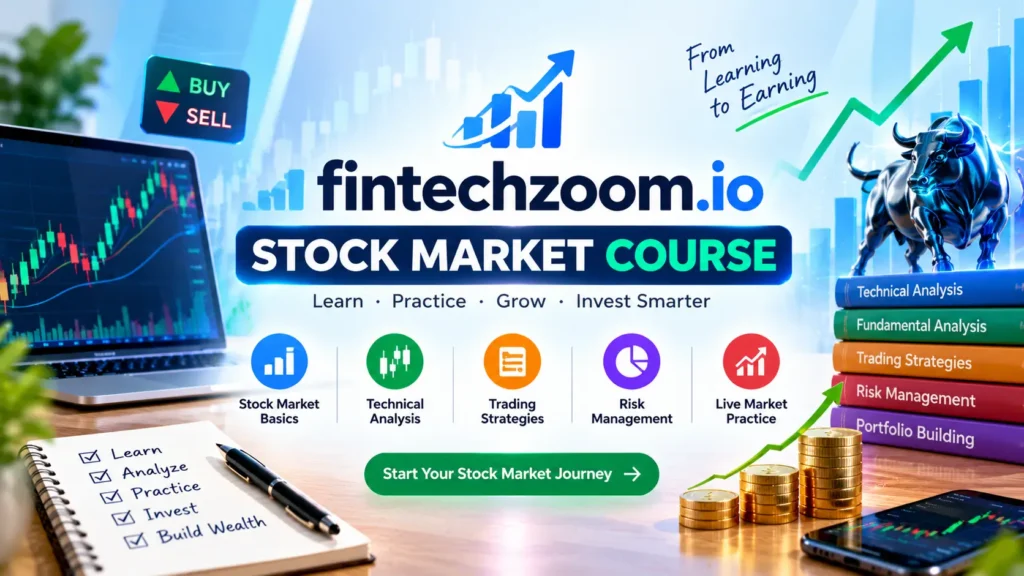
The FintechZoom.io stock market course is an online financial education offering that advertises lessons covering stock trading, investment strategies, technical analysis, risk management, and portfolio building. Rather than offering one clearly defined program, FintechZoom.io lists two separate stock-focused courses: the Stock Market Trading Mastery Course and the FintechZoom Investment Mastery Course. Both are presented as self-paced learning options for beginners and individuals who want to improve their understanding of financial markets.
The trading program advertises approximately four to six hours of video lessons, while the investment program lists seven to eight hours. The website also promotes quizzes, downloadable learning resources, certificates of completion, and learner support. However, important information about course pricing, named instructors, and independent student outcomes remains unclear.
There is also a significant website identity concern. FintechZoom.com publicly states that FintechZoom.io is not affiliated with its organization and identifies the .io domain among websites it considers to be impersonating its brand. This does not independently establish that every course claim is fraudulent, but it makes verification essential before enrollment or payment.
This comprehensive 2026 review examines the advertised curriculum, learning features, potential benefits, limitations, safety concerns, and practical questions prospective students should consider.
What Is the FintechZoom.io Stock Market Course?
The FintechZoom.io stock market course refers to financial education programs promoted on the FintechZoom.io website. The platform presents itself as a source of information about stock markets, financial technology, cryptocurrencies, market trends, and investment strategies.
Its courses section lists three educational areas: Financial Literacy, Stock Market Trading, and Stock Market Investing. The two stock-focused programs serve different learning objectives.
The trading course concentrates on understanding market movements, reading charts, exploring trading strategies, and managing the risks associated with buying and selling financial instruments. The investing course emphasizes longer-term financial planning, asset allocation, diversification, and portfolio management.
These subjects are relevant to financial education, but the existence of course descriptions does not independently verify the quality of the lessons or the qualifications of the instructors.
Prospective students should distinguish between what the website advertises and what has been independently confirmed.
How Does the FintechZoom.io Stock Market Course Work?
FintechZoom.io describes its courses as self-paced programs that allow learners to study through online video lessons and supporting materials.
The published descriptions suggest that students can work through educational modules covering financial concepts, market analysis, and practical strategies. The provider also advertises interactive quizzes, worksheets, charts, and other downloadable resources.
Its general courses page claims that students receive access to ongoing updates, assistance from finance experts, and a learning community. It also advertises a 30-day satisfaction guarantee.
However, these are statements made by the website itself. The complete student experience, quality of instruction, availability of support, and actual refund process have not been independently demonstrated through a verified course walkthrough.
The public pages also do not clearly display a standard enrollment price.
Before joining, readers should request written information explaining exactly which lessons, resources, support services, and access conditions are included in their purchase.
FintechZoom.io Stock Market Trading Mastery Course
The Stock Market Trading Mastery Course is designed around the more active side of financial markets. Its advertised topics include trading fundamentals, candlestick charts, technical indicators, price trends, day trading, swing trading, position trading, and trading psychology.
The program also introduces stop-loss strategies, portfolio allocation, margin trading, options, foreign exchange markets, and algorithmic trading.
These topics are appropriate for a broad introduction to market speculation, although several are complex enough to require substantial additional study.
The website advertises four to six hours of on-demand video content. That amount of instruction may introduce important concepts, but it is not sufficient by itself to demonstrate mastery of technical analysis, professional trading, or advanced derivatives.
Active trading requires considerable practical experience, ongoing market research, and disciplined risk controls.
Students should therefore approach the program as a possible introduction rather than a guaranteed route to becoming profitable traders.
What Does the Trading Course Teach?
The trading syllabus begins with basic market concepts, including how financial instruments are bought and sold and how prices respond to supply, demand, company developments, and broader economic conditions.
Technical analysis forms another part of the program. Learners are introduced to candlestick patterns, price trends, market indicators, and chart interpretation.
The course also advertises instruction in different trading styles. Day trading involves opening and closing positions within the same trading day, while swing trading generally involves holding positions for several days or weeks. Position trading may involve longer holding periods.
Risk management is another advertised subject, including stop-loss strategies, position allocation, and emotional discipline.
The curriculum additionally introduces advanced topics such as trading automation and margin accounts.
However, learning the vocabulary of these techniques is different from developing a tested strategy. Students should expect to practice independently and evaluate whether any method has a realistic financial advantage after accounting for costs and losses.
FintechZoom.io Investment Mastery Course
The Investment Mastery Course takes a different approach by focusing on longer-term financial planning and investment portfolio development.
The program advertises seven to eight hours of on-demand video lessons and includes topics such as stocks, bonds, exchange-traded funds, mutual funds, real estate, and alternative investments.
It also describes instruction in diversification, asset allocation, compounding, dividend investing, value investing, and passive index strategies.
Additional subjects include international investing, economic indicators, market volatility, behavioral finance, taxation, and wealth preservation.
The course also introduces more advanced areas such as options, futures, algorithmic trading, artificial intelligence, and robo-advisors.
For beginners, the wide curriculum may provide an overview of how different investments and financial decisions fit together.
However, its scope is unusually broad relative to the advertised seven-to-eight-hour duration. Readers should not assume that every advanced subject receives comprehensive treatment.
Trading Course vs. Investing Course: Which Is Different?
The main difference is the intended investment timeframe and decision-making process.
The trading course concentrates on market price movements, potential entry and exit opportunities, technical indicators, and short-term risk management. It may appeal to people who want to understand how active traders analyze markets and execute transactions.
The investing course focuses more heavily on financial objectives, portfolio construction, diversification, and wealth management over longer periods.
A person preparing for retirement or studying long-term investing may find the investment curriculum more relevant. Someone learning about chart analysis and trading psychology may prefer the trading syllabus.
However, neither course should be treated as a substitute for regulated professional advice or a promise of financial success.
For most complete beginners, understanding saving, emergency funds, basic investing risks, diversification, and investment costs is a sensible foundation before exploring short-term speculation.
Understanding Stock Market Fundamentals
One of the most valuable subjects in any beginner stock market course is understanding what a share of stock represents.
A stock represents an ownership interest in a company. Investors may benefit when the company’s value increases or when it distributes dividends, but they may also experience losses if the share price declines.
Stock prices can change because of earnings announcements, interest rates, economic developments, industry conditions, investor expectations, and many other factors.
Beginners should understand the difference between owning an individual company’s shares and investing through a diversified fund.
They should also learn how different orders work, including market orders and limit orders, and how brokerage fees, trading spreads, and taxes may affect results.
These foundational concepts are more important than attempting to predict every short-term price movement.
A useful stock market course should help students develop realistic expectations rather than encourage impulsive trading.
Technical Analysis and Chart Reading
Technical analysis involves examining historical market prices, trading volume, and patterns to help organize trading decisions.
The FintechZoom.io trading syllabus specifically mentions candlestick patterns, price trends, and market indicators.
Candlestick charts display opening, closing, high, and low prices over a selected period. Traders may examine these patterns alongside support levels, resistance levels, moving averages, and momentum indicators.
However, no chart pattern can predict future stock prices with certainty.
Market conditions change, and techniques that appeared effective historically may perform poorly when volatility, liquidity, or economic circumstances shift.
Students should also distinguish between identifying a possible trading setup and having a statistically tested strategy.
A useful learning exercise involves recording hypothetical trades and comparing results with transaction costs, missed opportunities, and actual market movement.
The most important lesson is that technical tools can help structure decisions, but they cannot eliminate uncertainty.
Fundamental Analysis for Long-Term Investors
Fundamental analysis evaluates a company’s financial condition, business model, competitive environment, and potential value.
Although the FintechZoom.io investment syllabus emphasizes market analysis, long-term investors should also learn how to examine company financial statements.
Important information includes revenue, profit margins, cash flow, debt, operating expenses, and the company’s ability to maintain competitive advantages.
Valuation measures such as the price-to-earnings ratio can help investors compare businesses, but they should not be used without context.
A company with a low valuation might be undervalued, or it might be experiencing serious financial difficulties.
Similarly, a rapidly growing business may appear expensive because investors expect strong future earnings.
Students should understand that financial statements reveal historical and current information, not guaranteed future performance.
A balanced investment decision considers both potential opportunities and reasons an investment could lose value.
Risk Management and Capital Protection
Risk management is among the most important subjects advertised in the FintechZoom.io courses.
For traders, this includes deciding how much money could be lost on a position, understanding the consequences of leverage, and maintaining clear rules for entering and exiting trades.
For long-term investors, risk management also involves diversification, asset allocation, time horizon, and the relationship between investments and personal financial objectives.
A stop-loss order may help limit losses under certain conditions, but it does not guarantee execution at a particular price. Rapid market movements can produce significantly different execution prices.
Likewise, diversification can reduce concentration risk, but it cannot eliminate losses during a broad market decline.
Borrowing money to trade introduces additional dangers because losses may exceed the original amount invested.
Beginners should prioritize understanding these risks before committing real capital.
No educational course can remove market uncertainty or guarantee profitable results.
Trading Psychology and Emotional Discipline
Financial markets involve more than numbers and charts. Investors and traders must also manage their reactions to uncertainty.
The FintechZoom.io trading curriculum mentions psychology, emotional discipline, and strategies for handling market volatility.
Common behavioral mistakes include chasing rapidly rising stocks, selling in panic during declines, taking excessive risks after a profitable trade, and refusing to acknowledge losses.
Another problem is confirmation bias, which occurs when investors focus on information supporting an existing opinion while ignoring contrary evidence.
A useful learning program should encourage students to document their decisions and understand why they entered or exited a position.
Keeping a trading journal can help identify repeated mistakes and evaluate whether a strategy is being followed consistently.
However, emotional control alone does not create a profitable investment strategy.
Discipline is valuable only when combined with sound analysis, appropriate risk limits, and realistic expectations.
Advanced Topics: Options, Margin and Algorithmic Trading
The trading and investing courses advertise introductions to advanced financial subjects, including options, margin trading, algorithmic strategies, and automated investing.
Options are derivative contracts whose value depends on an underlying asset. Depending on the strategy, they may be used for speculation or risk management, but some options positions can generate substantial losses.
Margin trading involves borrowing from a broker to increase purchasing power. It can magnify gains but also amplify losses and create additional financial obligations.
Algorithmic trading uses programmed rules to generate or execute transactions. Its effectiveness depends on data quality, execution conditions, strategy design, and changing market behavior.
Automated trading should not be confused with guaranteed profitability.
Students should be particularly cautious when promotional material combines these advanced topics with suggestions of easy income.
An introductory course may explain their purpose, but responsible use generally requires more comprehensive education and risk evaluation.
FintechZoom.io Course Duration and Learning Materials
The website lists different video durations for its two stock-focused programs.
The trading course advertises approximately four to six hours of on-demand lessons, while the investing course advertises seven to eight hours.
The trading program also mentions downloadable charts and strategy guides, and the investing course lists printable worksheets.
Both promote interactive quizzes and certificates of completion.
These features may make structured learning more convenient, especially for students who prefer organized lessons to unrelated videos.
However, a published duration does not establish instructional depth, the number of modules, the quality of examples, or how much independent practice learners should complete.
The public descriptions also do not clearly identify all instructors by name.
Before enrolling, prospective students should request a detailed lesson outline, a sample class, and information confirming that the advertised resources are actually available.
How Much Does the FintechZoom.io Stock Market Course Cost?
A current, independently verified enrollment price for the FintechZoom.io stock market course could not be established from its publicly accessible course descriptions.
The website advertises course benefits and encourages visitors to contact the provider, but a standard, clearly displayed purchase price was not available in the reviewed information.
This makes it difficult to assess whether the programs provide good value compared with other educational resources.
Prospective students should request the complete price in writing before paying.
The total cost should include any registration charges, recurring subscription fees, certificate costs, additional learning materials, software subscriptions, and applicable taxes.
It is also important to understand whether payment provides access to one course or several programs.
A website advertising extensive learning features without displaying clear pricing does not automatically establish wrongdoing, but it does make independent comparison more difficult.
Does FintechZoom.io Offer a Refund Policy?
FintechZoom.io’s general courses page advertises a 30-day satisfaction guarantee and states that dissatisfied learners can request a refund.
The same page promotes lifetime access to course materials and updates.
However, the complete contractual terms were not independently verified through an actual enrollment transaction.
Students should confirm whether the refund guarantee applies to their particular course and what conditions affect eligibility.
Important questions include when the 30-day period begins, whether watching lessons changes eligibility, whether downloaded materials affect refunds, and how long refund processing takes.
Any restrictions should be provided in writing before payment.
Buyers should also maintain records of advertisements, invoices, terms, and communications.
If a provider cannot supply clear written refund conditions, that uncertainty should be considered before purchasing.
Is FintechZoom.io the Same as FintechZoom.com?
No affiliation should be assumed between the two websites.
FintechZoom.com publicly identifies itself as the official FintechZoom domain and specifically lists FintechZoom.io among websites it says are not affiliated with its organization.
Its warning also raises concerns about websites using similar names to create confusion and potentially collect personal or financial information.
Meanwhile, FintechZoom.io operates its own financial information pages and advertises courses using the FintechZoom name.
The fact that both websites contain similar branding does not establish that they share ownership, instructors, business operations, or customer service.
This distinction is especially important because financial education websites may ask visitors to provide contact information, payment details, or account credentials.
Prospective students should verify the exact domain and legal business identity before enrolling.
The affiliation dispute is a material consideration that should not be omitted from any balanced review.
Is the FintechZoom.io Stock Market Course Legit?
The FintechZoom.io website has publicly accessible pages advertising stock market education. Its course descriptions are detailed enough to identify the broad topics being promoted.
However, that alone does not establish that the courses deliver every advertised feature or meet professional educational standards.
Several matters remain unverified, including named instructor credentials, independently documented student outcomes, current pricing, enrollment conditions, and the value of its completion certificate.
More importantly, FintechZoom.com has issued an explicit non-affiliation and impersonation warning concerning the .io domain.
This is a serious reason for caution, although it is not the same as a court finding or regulatory determination that a particular transaction was fraudulent.
The appropriate conclusion is that the course offerings are advertised, but their quality, business identity, and purchasing arrangements require independent verification.
Readers should not provide sensitive financial information until these questions are satisfactorily resolved.
Is the FintechZoom.io Course Certificate Recognized?
Both stock-focused programs advertise certificates of completion. The trading course says participants can receive a certificate after completing the program, while the investment course makes a similar claim.
However, a certificate of completion is not automatically equivalent to an accredited academic qualification, securities license, or professional financial planning credential.
The website’s public descriptions do not establish recognition by a university, government regulator, or established professional certification body.
Students considering the courses for career development should ask what organization issues the certificate, whether assessments are required, and whether employers recognize the qualification.
For someone learning personal finance, a certificate may be less important than the knowledge gained. For someone pursuing professional work in financial services, accreditation and regulatory requirements may be essential.
Who Should Consider the FintechZoom.io Stock Market Course?
The advertised curriculum may interest beginners who want an introduction to market terminology, chart reading, diversification, and investment planning.
It may also appeal to working professionals seeking a structured overview of financial concepts.
However, students should approach enrollment cautiously until the site’s identity, payment terms, instructor credentials, and actual teaching materials have been verified.
People seeking an accredited financial qualification should not assume that these courses meet professional requirements.
Likewise, individuals expecting guaranteed trading profits are likely approaching financial education with unrealistic expectations.
Beginners may benefit from studying free educational resources provided by established financial regulators before considering a paid program.
The quality of a course should ultimately be measured by its accuracy, transparency, teaching standards, and usefulness—not simply its promotional language.
How to Evaluate the Course Before Enrolling
Before purchasing the FintechZoom.io stock market course, prospective students should investigate the provider’s identity and compare its advertised curriculum with their learning objectives.
A trustworthy course provider should be able to identify the organization responsible for operating the program and explain who teaches the lessons.
It should also provide clear pricing, a complete syllabus, access requirements, and written refund conditions.
Students should request a sample lesson to evaluate teaching quality. They should also investigate whether independent reviews describe actual attendance rather than merely repeating promotional claims.
The warning published by FintechZoom.com makes confirming the website’s identity particularly important.
Avoid sharing passwords, brokerage credentials, cryptocurrency recovery phrases, or unnecessary financial information with an unverified educational provider.
Anyone using a trading simulator should preferably practice without connecting real brokerage accounts until they understand the platform and associated risks.
A Practical Learning Plan for Stock Market Beginners
New investors can develop useful knowledge through a structured study plan, regardless of which course they eventually choose.
During the first week, focus on basic concepts such as shares, stock exchanges, market orders, dividends, exchange-traded funds, and investment risk. Understanding these terms helps make later lessons easier to follow.
During the second week, study company financial statements, diversification, and the difference between long-term investing and short-term trading. Learn how fees and taxes can affect investment results.
The third week can focus on technical charts and trading terminology. Practice identifying trends and market movements without assuming that historical patterns guarantee future prices.
During the fourth week, develop a hypothetical investment plan based on financial goals, risk tolerance, and time horizon.
Finally, review decisions using a paper-trading account or hypothetical portfolio. Record the reasoning behind each decision and evaluate mistakes without risking real savings.
This approach emphasizes learning and risk awareness rather than chasing immediate profits.
Frequently Asked Questions About the FintechZoom.io Stock Market Course
1. What is the FintechZoom.io stock market course?
The FintechZoom.io stock market course refers to online education programs advertised by FintechZoom.io. Its website lists separate courses for stock market trading and long-term investing, covering market analysis, risk management, and financial strategies.
2. Is the FintechZoom.io stock market course good for beginners?
The website advertises both courses as beginner-friendly. However, their teaching quality and instructor qualifications have not been independently established, so prospective students should verify the details before enrolling.
3. Is the FintechZoom.io stock market course free?
A publicly confirmed enrollment price was not available in the reviewed course descriptions. It should not be assumed that the programs are free. Request written pricing and payment terms before signing up.
4. How much does the FintechZoom.io stock market course cost?
The current course fee has not been independently verified. Students should ask for the full price, including possible taxes, recurring charges, learning materials, and certificate-related costs.
5. How long does the FintechZoom.io trading course take?
The Stock Market Trading Mastery Course advertises approximately four to six hours of on-demand video instruction. Additional time may be required for independent research and practice.
6. What does the FintechZoom.io investing course teach?
The investment program covers asset allocation, diversification, compounding, stocks, bonds, ETFs, value investing, portfolio management, and selected advanced investment topics. It advertises seven to eight hours of lessons.
7. Is FintechZoom.io a legitimate website?
FintechZoom.io publishes course pages, but important details about its educational offerings remain unverified. FintechZoom.com also explicitly states that the .io website is not affiliated with its organization and has issued an impersonation warning.
8. Does the FintechZoom.io course provide a certificate?
Yes, the website advertises certificates of completion. However, independent accreditation or professional recognition of those certificates has not been established.
9. Does FintechZoom.io offer refunds?
Its general courses page advertises a 30-day satisfaction guarantee. Prospective students should obtain the specific refund conditions in writing and confirm they apply to the intended course.
10. Can the FintechZoom.io stock market course help you make money?
Financial education may improve understanding of investment decisions, but it cannot guarantee profitable trading or investment returns. Actual results depend on market conditions, personal decisions, costs, and risk exposure.
Final Thoughts
The FintechZoom.io stock market course presents a broad introduction to trading, investing, market analysis, and financial decision-making. Its two main stock-focused programs cover different objectives, with the Trading Mastery Course concentrating on active market strategies and the Investment Mastery Course emphasizing portfolio construction and longer-term financial planning.
The advertised curriculum includes useful subjects such as diversification, risk management, technical analysis, investment psychology, and market fundamentals. However, the public information leaves important questions concerning pricing, instructors, actual course delivery, student outcomes, and the professional value of its certificates.
The most significant concern is the explicit warning from FintechZoom.com stating that FintechZoom.io is not affiliated with its organization. This makes independent verification especially important before submitting payment or personal information.
For beginners exploring stock market education in 2026, the practical priority should be building financial knowledge, understanding market risks, and choosing transparent educational providers. A course can introduce valuable concepts, but sound investing requires continued learning, careful research, and realistic expectations rather than promises of quick financial success.
For More Visits: Ourmmagazine

















Leave a Comment
Your email address will not be published. Required fields are marked with *