
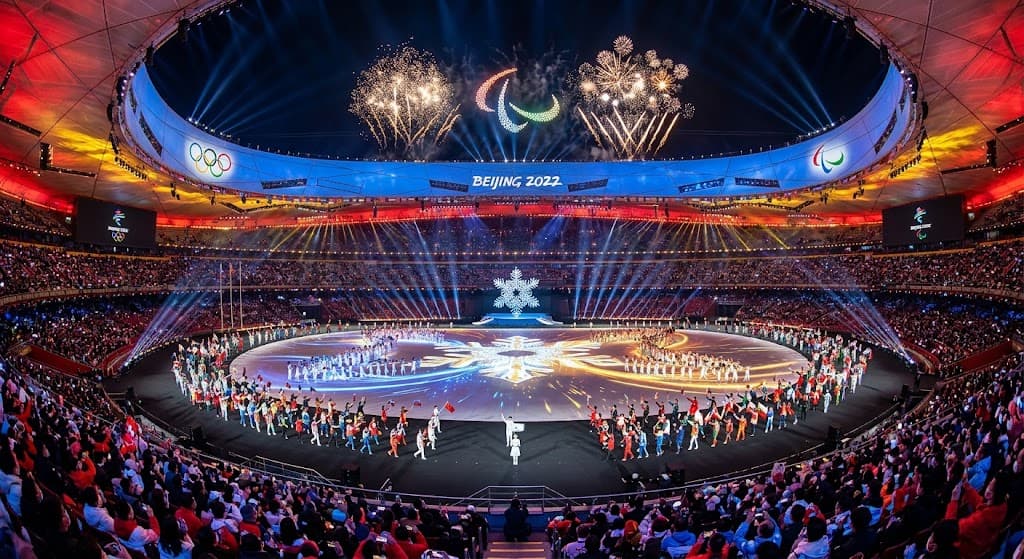
The 2022 Winter Paralympics opening ceremony marked the beginning of an international sporting event that brought together athletes with disabilities from around the world. Held in Beijing, China, on March 4, 2022, the ceremony welcomed competitors, officials, and spectators for the 13th edition of the Winter Paralympic Games. It celebrated athletic achievement while emphasizing inclusion,
The 2022 Winter Paralympics opening ceremony marked the beginning of an international sporting event that brought together athletes with disabilities from around the world. Held in Beijing, China, on March 4, 2022, the ceremony welcomed competitors, officials, and spectators for the 13th edition of the Winter Paralympic Games. It celebrated athletic achievement while emphasizing inclusion, dignity, and the importance of creating opportunities for people with disabilities.
The ceremony took place at Beijing National Stadium, widely known as the Bird’s Nest. The stadium had already become an internationally recognized landmark during the 2008 Summer Olympic Games, and its use for the Winter Paralympics added another chapter to Beijing’s sporting history. Through ceremonial performances, the athletes’ parade, official speeches, and the lighting of the Paralympic cauldron, the event established the atmosphere for the competitions that followed.
The opening ceremony was also significant because it occurred during a difficult period for international sport. The COVID-19 pandemic continued to affect travel and public events, while the geopolitical circumstances surrounding the 2022 Games placed additional attention on the relationship between sport and international affairs. Against this background, the ceremony presented the Paralympic movement’s central message: athletes should have the opportunity to compete, demonstrate their abilities, and participate in international sporting life.
Quick Facts About the 2022 Winter Paralympics Opening Ceremony
| Detail | Information |
|---|---|
| Event | 2022 Winter Paralympics Opening Ceremony |
| Date | March 4, 2022 |
| Venue | Beijing National Stadium, also known as the Bird’s Nest |
| Location | Beijing, China |
| Games | 2022 Winter Paralympic Games |
| Edition | 13th Winter Paralympic Games |
| Central theme | “Blossoming of Life” |
| Opening declaration | Xi Jinping, President of China |
| Paralympic movement representative | Andrew Parsons, President of the International Paralympic Committee |
| Cauldron lighter | Li Duan, Chinese Paralympic athlete |
| Competition dates | March 4–13, 2022 |
| Main message | Inclusion, accessibility, participation, and sporting excellence |
What Was the 2022 Winter Paralympics Opening Ceremony?
The 2022 Winter Paralympics opening ceremony was the official event that introduced the Beijing Winter Paralympic Games to the world. It brought together participating delegations and representatives of the international Paralympic movement before the beginning of the competitions.
Opening ceremonies have several important functions. They establish the identity of an event, introduce participating teams, recognize the athletes who have worked to reach the international stage, and formally mark the start of the Games. At the Paralympics, they also provide an opportunity to discuss accessibility, equal participation, and the place of athletes with disabilities in global sport.
The Beijing ceremony followed these traditions while reflecting the host city’s cultural presentation and the broader themes associated with the Paralympic movement. Its central theme, commonly translated as “Blossoming of Life,” connected the event with ideas of growth, possibility, and the value of human participation.
Rather than being simply a prelude to sporting competitions, the ceremony served as a public statement about the role of the Paralympics. It highlighted athletes not merely as representatives of disability but as competitors whose training, technical ability, determination, and tactical decisions would define their performances during the Games.
The distinction matters because disability sport is sometimes presented through narratives that focus almost entirely on personal hardship. The Paralympic movement offers a broader perspective. It recognizes individual experiences while placing athletic performance, fair competition, and opportunities for participation at the center of the event.
When and Where Did the Ceremony Take Place?
The opening ceremony took place on March 4, 2022, at Beijing National Stadium in Beijing, China. The Winter Paralympic Games continued until March 13, making the ceremony the formal beginning of a ten-day international sporting program.
Beijing National Stadium: The Bird’s Nest
<PRIVATE_PERSON>Beijing National Stadium, commonly called the Bird’s Nest because of its distinctive architectural structure, is one of the best-known sports venues in China. It was originally built for the 2008 Summer Olympic Games and became internationally recognizable through its design and role in that event.
Its selection for the Winter Paralympics created a connection between Beijing’s Olympic history and its role as a host of winter sporting events. The stadium provided a large venue for the opening proceedings, including the presentation of participating delegations and the central ceremonial elements.
The venue was particularly significant because Beijing had already hosted the Summer Olympics in 2008. By hosting the 2022 Winter Olympics and Paralympics, the city further strengthened its position in Olympic history. Beijing became the first city to host both the Summer and Winter editions of the Olympic Games.
This achievement demonstrated the scale of the city’s sporting infrastructure and its capacity to accommodate events associated with different seasons and disciplines. However, the Paralympic Games also raised questions beyond venue design, including the importance of accessible transport, suitable accommodation, inclusive public services, and the practical needs of athletes with different disabilities.
A successful international sporting event requires more than an impressive stadium. It depends on an environment in which competitors can move, train, communicate, and participate as independently and safely as possible.
A Ceremony During a Challenging Period
The 2022 Winter Paralympics took place while the world was still dealing with the effects of COVID-19. International travel, public gatherings, and sporting schedules had all been affected by the pandemic.
The Beijing Games operated under extensive health and operational arrangements intended to manage the risks associated with the virus. These circumstances influenced how major international events were organized and experienced.
The ceremony therefore represented not only the beginning of another Paralympic competition but also the continuation of international sport under exceptional conditions. Athletes had to prepare for competition in an environment shaped by public-health measures and restrictions that were different from those experienced at many previous editions.
The broader international context also attracted attention. Political tensions surrounding the Games demonstrated that major sporting events do not take place in isolation from world affairs. Nevertheless, the sporting purpose remained central for the competitors who had spent years preparing for their events.
The Theme: “Blossoming of Life”
One of the defining elements of the ceremony was its theme, “Blossoming of Life.” The phrase suggested growth, renewal, and the possibility of development. In the context of the Paralympics, it could be understood as an expression of the value of every person’s participation in society and sport.
The theme was particularly relevant to an event featuring athletes whose experiences and requirements varied widely. Paralympic competitors may have physical, visual, or other eligible impairments, and the sports they enter use different classification systems and adaptations. Their experiences are not interchangeable, and no single story can represent every athlete.
The idea of blossoming offered a way to recognize individual potential without suggesting that disability itself should be treated as a tragedy or that athletes must overcome every barrier through personal determination alone.
Sporting participation depends on individual effort, but it also depends on the availability of training, coaching, equipment, funding, accessible facilities, transportation, and competitive opportunities. A more inclusive sporting environment is created when these conditions allow people with disabilities to pursue their ambitions.
Inclusion as a Central Message
Inclusion means more than inviting athletes to participate in a major event. It involves ensuring that people can take part meaningfully and that their achievements are recognized on their own terms.
For athletes with disabilities, access to sport can be influenced by factors such as the availability of adaptive equipment, specialist coaching, accessible venues, and opportunities to compete at local and national levels. These conditions often develop over many years and can differ significantly between countries and communities.
The Paralympics places these issues in a highly visible international setting. Athletes competing at this level demonstrate advanced technical skills, physical preparation, strategic judgment, and the ability to perform under pressure.
The opening ceremony’s inclusive message was therefore connected to the sporting program that followed. The event introduced competitors who would soon be judged by the same fundamental standards that apply throughout elite sport: performance, rules, fair competition, and results.
Why the Theme Was Relevant Beyond the Stadium
The themes associated with the ceremony extended beyond the ten days of competition. International sporting events can encourage public discussion about the barriers that prevent people with disabilities from accessing sport, education, employment, transportation, and cultural activities.
However, public awareness alone does not automatically produce lasting change. Meaningful inclusion requires practical measures, such as accessible buildings, properly designed public spaces, inclusive policies, and opportunities for people with disabilities to participate in decisions that affect them.
The Paralympics can contribute to these conversations by making elite disability sport visible. The most meaningful legacy emerges when the attention generated by the Games supports wider access to sport and everyday public life.
The Official Opening of the Games
The ceremony included formal proceedings that established the official beginning of the 2022 Winter Paralympics. These proceedings formed part of the established structure of major international sporting events.
Xi Jinping, President of China, declared the Games open. His role as the host country’s head of state placed the declaration within the formal protocol of the ceremony.
The event also featured Andrew Parsons, president of the International Paralympic Committee (IPC), who represented the international Paralympic movement. The IPC is responsible for leading the Paralympic movement and overseeing the Winter and Summer Paralympic Games.
Andrew Parsons and the Paralympic Movement
The IPC plays a central role in organizing and developing elite sport for athletes with disabilities. It works with international sporting bodies and national Paralympic committees to support competitions, establish rules and classifications, and promote the movement’s broader objectives.
Andrew Parsons served as IPC president during the Beijing Games. His participation in the opening ceremony connected the event with the organization responsible for the international Paralympic framework.
The Paralympic movement has developed considerably since its early beginnings. What started as a sporting initiative associated with rehabilitation after the Second World War evolved into an international competition featuring elite athletes from many countries and a wide range of sports.
Modern Paralympic competition emphasizes high performance and structured competition. Athletes train for specific events, follow sport-specific regulations, and compete within classification systems designed to support fairer comparisons between competitors.
The opening ceremony provided a public introduction to this movement before the attention shifted to the results and performances that would emerge during the Games.
The Importance of the Opening Declaration
The official declaration is a formal milestone rather than a sporting result. It does not determine who will win medals or how individual competitions will unfold. Instead, it marks the transition from preparation and anticipation to the Games themselves.
For athletes, this moment represents the beginning of an opportunity to demonstrate the work they have completed over months and years. For national delegations, it is a chance to represent their countries in an international sporting environment.
For spectators, the declaration signals that the competitive program is about to begin. The ceremony brings together the symbolic, administrative, and human elements of the event before the athletes take to the slopes, tracks, and ice.
The Athletes’ Parade: Celebrating International Participation
The parade of athletes is one of the most recognizable traditions of the Olympic and Paralympic opening ceremonies. Delegations enter the stadium and represent the countries or territories participating in the Games.
The parade provides a moment of collective recognition before competitors become focused on their individual events. It allows athletes from different sporting backgrounds to appear together as part of a wider international community.
At the Winter Paralympics, the parade also demonstrates the diversity of disability sport. Athletes may compete using different equipment and adaptations depending on their sports and individual requirements. Some compete standing, others sit on specialized equipment, and visually impaired athletes may rely on guides in relevant disciplines.
These differences reflect the practical ways in which sports are organized to enable eligible athletes to compete. They should not overshadow the fact that each event has its own technical demands and competitive standards.
National Representation and Team Identity
Representing a country at a Paralympic Games is a significant achievement. Athletes generally reach this level through years of preparation, participation in qualifying competitions, and cooperation with coaches and support teams.
The parade recognizes that achievement before the competition begins. It also reflects the importance of national Paralympic committees and the systems that help athletes progress from grassroots sport to international competition.
Team identity can be meaningful for competitors, but the Games also create opportunities for interaction between people from different cultures and sporting backgrounds. Athletes may share training knowledge, develop friendships, and gain a deeper understanding of how disability sport operates in other countries.
These exchanges are part of the wider value of international competition. Although medals are an important measure of sporting success, the relationships and experiences developed through participation can also be significant.
Recognizing Athletes as Competitors
A respectful understanding of the athletes’ parade starts by recognizing the participants as sportspeople. Their disabilities may influence their equipment, classification, or method of competition, but they do not define every aspect of their identities.
Paralympic athletes are individuals with different goals, personalities, training histories, and approaches to competition. Some aim to win medals, while others may be pursuing personal bests, representing their countries for the first time, or returning after previous international appearances.
Their performances deserve the same serious attention given to elite sport in general. Results can depend on technique, physical conditioning, weather, equipment, strategy, and the decisions made during a competition.
The parade makes these athletes visible to a global audience before the detailed stories of individual events begin.
The Lighting of the Paralympic Cauldron
The lighting of the Paralympic cauldron is one of the most symbolically important moments in an opening ceremony. It represents the transition into the Games and connects the ceremony with the history and identity of the Paralympic movement.
At Beijing 2022, the cauldron was lit by Li Duan, a Chinese Paralympic athlete who had won four Paralympic gold medals in athletics field events. Li Duan is visually impaired, and his participation in this central moment connected the ceremony directly to the athletes whose performances give the Games their meaning.
The choice of a Paralympic athlete for this role was significant because the ceremony was not simply welcoming competitors into a venue. It was celebrating a sporting movement shaped by their achievements and participation.
Who Was Li Duan?
Li Duan is known for his achievements in Paralympic athletics, particularly in field events. His record as a four-time Paralympic gold medalist established him as an accomplished competitor before he took part in the Beijing opening ceremony.
His role as cauldron lighter brought attention to an athlete whose sporting career had already contributed to the history of the Paralympic movement.
The moment also illustrated an important principle: athletes with disabilities should be recognized for their achievements, expertise, and participation rather than being represented only through general stories about hardship.
Li Duan’s sporting record gave his appearance a direct connection to elite competition. The lighting of the cauldron became a moment in which the ceremonial symbolism of the Games met the real achievements of a Paralympic athlete.
What the Cauldron Represents
The cauldron is a familiar feature of Olympic and Paralympic opening ceremonies. Its lighting symbolizes the beginning of the event and creates a visual connection between the opening proceedings and the competitions that follow.
Although the ceremony lasts only a limited period, the cauldron represents the much longer process of preparing for the Games. Athletes, coaches, technical officials, medical professionals, equipment specialists, and national organizations all contribute to making international competition possible.
The symbol can also represent continuity. Each edition of the Paralympics builds on the achievements, organizational experience, and sporting traditions of previous Games.
In Beijing, the cauldron lighting provided a clear focal point for the ceremony. It connected the official opening with the human stories and competitive ambitions that would unfold during the following days.
Performances and Visual Presentation
The opening ceremony combined formal protocol with artistic performances. As with other major sporting ceremonies, these elements helped create an atmosphere suited to the occasion while communicating themes associated with the host city and the event.
The performances included participants with and without disabilities, supporting the ceremony’s emphasis on inclusion. This approach placed disabled performers within the artistic presentation rather than treating disability as a subject that could only be discussed from a distance.
Artistic participation can be an important part of a public event because it allows people with different experiences to contribute to a shared presentation. It also demonstrates that inclusion can involve many forms of participation, from sport and performance to planning, leadership, and public communication.
Art as a Form of Communication
Opening ceremonies frequently use movement, music, lighting, staging, and coordinated visual elements to communicate ideas that might otherwise require long explanations.
The theme “Blossoming of Life” lent itself to imagery associated with growth and renewal. In a Paralympic setting, such imagery could connect with the idea that people should have opportunities to develop their abilities and participate in public life.
However, artistic symbolism should not be confused with a complete account of the realities faced by people with disabilities. A performance can express an inclusive ideal, but the implementation of that ideal requires practical changes in institutions and communities.
The lasting value of inclusive artistic participation depends partly on whether people with disabilities continue to have opportunities to contribute after the ceremony ends.
Balancing Celebration and Sporting Purpose
The ceremony needed to fulfill several purposes at once. It had to introduce the Games, recognize participating athletes, follow formal protocols, and offer an artistic presentation suitable for an international audience.
These elements work together when the spectacle supports rather than overshadows the competitors. The opening ceremony is a major public event, but the sporting competitions remain its central reason for existing.
The performances created a setting for the athletes’ arrival and the official opening. Afterward, attention could shift toward the disciplines, results, and individual contests that would determine the sporting outcomes of Beijing 2022.
The Six Sports at the 2022 Winter Paralympics
The opening ceremony introduced the sporting program of the 2022 Winter Paralympic Games. The event featured six sports, each with its own technical requirements, competition formats, and rules.
1. Para Alpine Skiing
Para alpine skiing involves downhill skiing events adapted for eligible athletes with different impairments. Depending on the athlete’s classification and discipline, competitors may ski standing, use a sit-ski, or compete with a guide.
The sport requires a combination of balance, speed control, technical precision, and tactical judgment. Course conditions and the ability to maintain a suitable racing line can have a major influence on performance.
2. Para Biathlon
Para biathlon combines cross-country skiing with target shooting. Athletes must manage the physical demands of skiing while maintaining the control and concentration needed for shooting.
The sport requires competitors to balance pace with accuracy. Depending on the competition category, adaptations may be used to make participation possible for eligible athletes with different impairments.
3. Para Cross-Country Skiing
Para cross-country skiing tests endurance, technique, pacing, and the ability to maintain performance over a distance. Competitors race over prepared snow courses, with classifications and equipment arrangements reflecting different eligible impairments.
Athletes must manage energy throughout the race and respond to changing terrain. Success depends on conditioning and technical efficiency as well as the ability to make sound decisions during competition.
4. Para Snowboard
Para snowboard features snowboard racing events for eligible athletes with impairments that affect their movement. Competitors race on snow courses and must combine board control, balance, speed, and awareness of the course.
The discipline has developed as an important part of the Winter Paralympic program, creating another competitive pathway for athletes in snow sports.
5. Para Ice Hockey
Para ice hockey, formerly commonly called sledge hockey, is a fast-paced team sport played on ice. Players use specially designed sledges and sticks to move around the rink and control the puck.
The sport requires teamwork, passing accuracy, tactical awareness, and quick reactions. As with other forms of ice hockey, coordination between teammates and the ability to respond to opponents are central to performance.
6. Wheelchair Curling
Wheelchair curling is a team sport played on ice in which players slide stones toward a target area. It uses the strategic principles of curling while adapting participation for athletes who compete using wheelchairs.
Teams must consider stone placement, the position of existing stones, and the likely responses of their opponents. Accuracy and tactical planning are central to success.
Together, these six sports demonstrate the range of competition available at the Winter Paralympics. They include individual races, endurance events, technical disciplines, and team sports, each requiring a distinct combination of skills.
Why the 2022 Winter Paralympics Mattered
The Beijing Winter Paralympics mattered for several reasons, including sporting performance, international visibility, and the continued development of disability sport.
The Games offered athletes an opportunity to compete at the highest international level in their disciplines. Reaching this stage requires more than personal motivation: competitors depend on coaching, training facilities, appropriate equipment, classification procedures, and access to suitable competitions.
For many athletes, the Paralympics represents the culmination of years of structured preparation. The opening ceremony recognizes that journey while preparing audiences to follow the competitive results.
Visibility and Public Understanding
International sporting events can increase public awareness of sports that receive less attention outside major competitions. The Paralympics gives audiences the opportunity to see the technical and tactical demands of disability sport directly.
Greater visibility can challenge assumptions about who participates in elite sport and what athletic performance looks like. It can also encourage young people with disabilities to explore sporting opportunities that might otherwise seem inaccessible.
Nevertheless, media representation matters. Coverage is most useful when it explains the sport, recognizes athletes’ expertise, and avoids reducing competitors to simplistic inspirational stories.
Athletes can be inspiring to audiences, but their value is not limited to inspiring others. They are competitors who deserve attention for their results, training, strategy, and professional sporting achievements.
Accessibility Beyond Major Events
The Paralympics also raises questions about access to sport outside elite competition. A country may host a major international event while people with disabilities in local communities continue to face barriers to recreational facilities, transport, or coaching.
The difference between elite competition and everyday participation is important. The Games can demonstrate what athletes achieve when they have access to the resources required for high-level performance. Wider inclusion requires those opportunities to exist at community and development levels as well.
Schools, local sports clubs, public authorities, and national sporting organizations can all contribute to improving access. This includes designing accessible facilities, training coaches, making equipment available, and ensuring that disabled people are included in decisions about sporting programs.
The Role of International Cooperation
The Paralympic movement depends on cooperation among national committees, international sports organizations, event organizers, athletes, and technical specialists.
International competition provides a common framework in which athletes can compete under established rules. Classification systems help organize eligible competitors into categories intended to support fairer competition, although their application and development require careful technical oversight.
The Games also encourage the exchange of experience between sporting systems. Knowledge about coaching, adaptive equipment, accessibility, and athlete development can help inform future programs.
These benefits do not emerge automatically from a single ceremony or competition. They depend on continued cooperation and the practical work that takes place between editions of the Games.
The Wider Context of Beijing 2022
The 2022 Winter Paralympics took place in a complicated international environment. The pandemic continued to affect how major events were organized, while political tensions surrounding the Games attracted attention beyond sport.
These circumstances are part of the historical context of Beijing 2022. They help explain why the event was discussed not only as a sporting competition but also in relation to public health, international relations, and the role of global sporting institutions.
At the same time, the circumstances surrounding a host country should not erase the achievements of the athletes who competed. Competitors prepare within the conditions available to them, and their performances deserve careful assessment on sporting grounds.
The opening ceremony offered a public starting point for the Games, but the competition itself would be defined by the athletes’ results, the application of sport-specific rules, and the conditions under which events took place.
A balanced historical account can recognize the broader context without turning an article about the ceremony into a political argument. It can acknowledge that major sporting events carry symbolic meaning while keeping the athletes and their sporting achievements in focus.
How the Ceremony Connected to Paralympic History
The Winter Paralympics developed from a wider movement to create competitive sporting opportunities for people with disabilities. Over time, the movement expanded in scale, sporting variety, and international recognition.
The modern Paralympic Games are not simply recreational events or demonstrations of rehabilitation. They are elite sporting competitions governed by formal rules, technical standards, and classification systems.
The opening ceremony in Beijing reflected this established identity. It followed recognizable traditions of major international sports events while presenting the Paralympics as a distinct competition with its own athletes, history, and mission.
Each new edition of the Games contributes to this history. Athletes establish new records, sporting organizations develop their programs, and audiences gain opportunities to understand disciplines they may not encounter regularly.
The history of the Paralympics is therefore not only a story about a ceremony or a host city. It is a continuing account of sporting development, institutional change, athlete achievement, and efforts to make participation more accessible.
For readers interested in related subjects, sporttörténeti és kulturális cikkek provide a natural starting point for exploring how major events connect sport with society and cultural history.
The Lasting Significance of the Opening Ceremony
The 2022 Winter Paralympics opening ceremony was important because it brought the athletes and the international Paralympic movement into focus at the start of the Beijing Games.
Its central theme, “Blossoming of Life,” emphasized growth and possibility. The participation of performers with and without disabilities supported the event’s inclusive message, while the athletes’ parade recognized the delegations preparing to compete.
The official opening declaration marked the beginning of the Games, and the lighting of the cauldron by Li Duan connected the ceremony to the achievements of a Paralympic athlete. These moments gave the event a clear ceremonial structure while reinforcing its connection to elite sport.
Yet the significance of the ceremony should not be measured only by its staging or symbolism. Its wider meaning lies in the sporting program that followed and in the continuing conversation about accessibility, opportunity, and the recognition of athletes with disabilities.
A ceremony can introduce these themes to a global audience, but long-term inclusion requires consistent action. Accessible facilities, suitable equipment, trained coaches, fair competition, and opportunities for young athletes are essential if more people are to participate in sport.
The Beijing ceremony therefore belongs to two histories at once: the history of a major international sporting event and the broader development of the Paralympic movement. Its message of participation and possibility remains relevant wherever athletes are working to access the resources and opportunities they need to compete.
Frequently Asked Questions
1. When was the 2022 Winter Paralympics opening ceremony held?
The ceremony took place on March 4, 2022, in Beijing, China. It marked the official beginning of the 2022 Winter Paralympic Games, which ran through March 13.
2. Where did the opening ceremony take place?
It was held at Beijing National Stadium, also known as the Bird’s Nest. The stadium was originally built for the 2008 Summer Olympic Games and later hosted major events connected with Beijing’s winter sporting program.
3. What was the theme of the 2022 Winter Paralympics opening ceremony?
The central theme was “Blossoming of Life.” It was associated with ideas of growth, possibility, inclusion, and the value of participation.
4. Who officially opened the 2022 Winter Paralympics?
Xi Jinping, President of China, declared the Games open during the ceremony.
5. Who lit the Paralympic cauldron in Beijing?
Li Duan, a Chinese Paralympic athlete and four-time Paralympic gold medalist in athletics field events, lit the cauldron.
6. Who was Andrew Parsons?
Andrew Parsons was the president of the International Paralympic Committee during the Beijing 2022 Games. He represented the international Paralympic movement at the opening ceremony.
7. How many sports were included in the 2022 Winter Paralympics?
The program included six sports: para alpine skiing, para biathlon, para cross-country skiing, para snowboard, para ice hockey, and wheelchair curling.
8. Why was the ceremony important?
It formally opened the Games, welcomed the participating delegations, and highlighted themes associated with inclusion and sporting participation. It also connected the Beijing event with the wider history of the Paralympic movement.
9. What made Beijing historically significant as a host city?
Beijing had hosted the Summer Olympic Games in 2008 before hosting the Winter Olympic and Paralympic events in 2022. It became the first city to host both the Summer and Winter editions of the Olympic Games.
10. Where can readers find more information about the ceremony?
Readers can explore the historical overview of the 2022 Winter Paralympics opening ceremony for additional details about the event and its place in the Games.
Conclusion: A Beginning That Went Beyond Ceremony
The 2022 Winter Paralympics opening ceremony in Beijing marked the start of ten days of international competition and renewed attention to the achievements of athletes with disabilities. Held at the Bird’s Nest on March 4, 2022, the event combined formal proceedings, artistic performances, the parade of athletes, and the lighting of the Paralympic cauldron.
The theme “Blossoming of Life” expressed an emphasis on possibility and participation. The presence of performers with and without disabilities, the official opening declaration, and Li Duan’s role as cauldron lighter gave the ceremony its distinctive character.
Ultimately, the opening ceremony was the beginning rather than the conclusion of the story. The sporting events that followed demonstrated the technical ability, preparation, and competitive ambition of Paralympic athletes. The broader challenge remains to turn the visibility created by major events into lasting access to sport and public life.
The historical significance of Beijing 2022 lies not only in its place on the international sporting calendar but also in its contribution to the continuing story of the Paralympic movement: a movement built around competition, opportunity, and the recognition of athletes for what they achieve.
For More Visits: Ourmagazine

















Leave a Comment
Your email address will not be published. Required fields are marked with *