
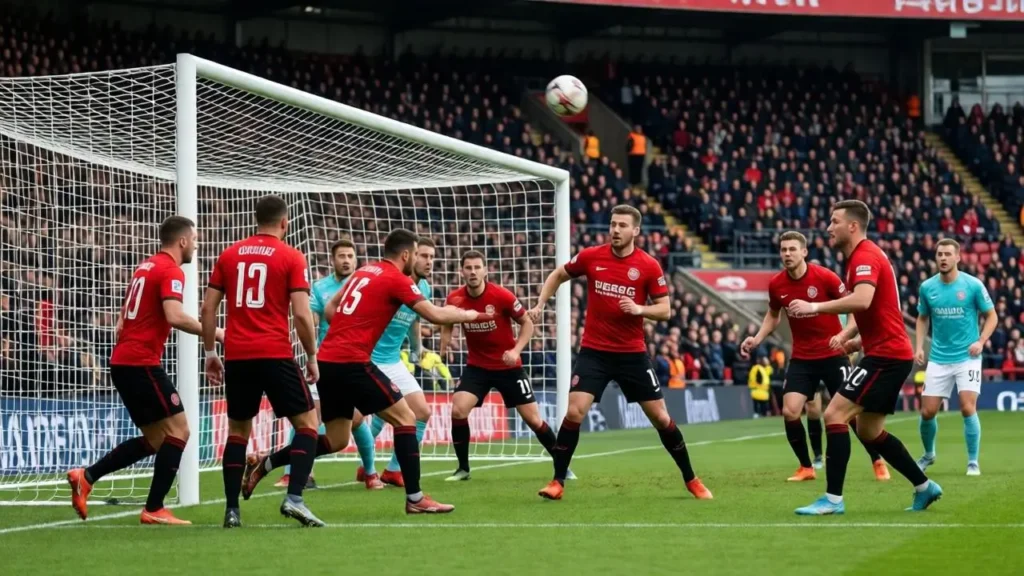
The corner flag becomes the center of attention as Liverpool prepare to restart play. The ball is placed carefully, defenders gather inside the penalty area, and the goalkeeper begins organizing the players in front of him. Liverpool’s attackers do not simply stand and wait for the cross. Some move toward the near post, others occupy
The corner flag becomes the center of attention as Liverpool prepare to restart play. The ball is placed carefully, defenders gather inside the penalty area, and the goalkeeper begins organizing the players in front of him. Liverpool’s attackers do not simply stand and wait for the cross. Some move toward the near post, others occupy deeper positions, while another player may remain outside the crowded area.
To the casual eye, it looks like a collection of players waiting for a ball into the box.
For those watching the details, something else is happening.
Every starting position can have a purpose. A runner can drag a defender away from his preferred position. A player standing near the goalkeeper can influence his view of the delivery. A delayed run can create separation at exactly the moment the ball arrives. Even an attacker who never touches the ball can contribute to the outcome.
This is where the idea behind reds exploit corner becomes interesting.
Liverpool’s corners can be viewed not simply as opportunities to cross the ball but as carefully constructed attacking situations. The team has a chance to place several players close to the opposition goal, organize movements in advance and challenge the defensive structure in a confined area.
The real battle begins before the corner is taken.
The attackers are trying to create space.
The defenders are trying to remove it.
The goalkeeper is trying to keep control of an increasingly crowded six-yard box.
And somewhere in the middle of that confrontation, the quality of the delivery and timing of the runs can turn a routine restart into a genuine attacking opportunity.
Why Corners Change the Normal Shape of Football
Open play gives defenders time and space to maintain their usual structure. A corner is different because both teams know exactly where the restart will begin.
That certainty creates an unusual tactical environment.
Liverpool can move several players into advanced positions without having to build the attack from midfield. The opposition, meanwhile, has to organize quickly around the penalty area and decide how responsibilities will be divided.
This is why attacking corners are so heavily dependent on positioning.
A defender might normally be comfortable defending a particular zone, but the arrival of several attackers can force him to make decisions that do not occur during ordinary play. Should he track a runner or remain in his zone? Should he stay close to the goalkeeper or attack the incoming ball? Should he follow an opponent across the penalty area or trust a teammate to take responsibility?
Liverpool can use those decisions to their advantage.
The objective is not necessarily to create complete confusion. In many cases, the more realistic objective is to make the defense react slightly later than the attack.
That small delay can be enough.
A runner who reaches the ball first has an obvious advantage over a defender who has to turn, adjust his feet and locate the incoming cross.
This is one reason why Reds corner kicks can be understood through movement rather than simply through delivery.
What “Reds Exploit Corner” Means in a Tactical Sense
The phrase reds exploit corner does not need to refer to one particular match or one famous Liverpool routine.
In a football context, it can describe the broader idea of Liverpool attempting to exploit weaknesses in the opposition’s organization during corner situations.
Those weaknesses can appear in several forms.
A defending team may struggle with runners attacking the near post. It may leave too much room around the far post. Its defenders may become disconnected when marking individual players. The goalkeeper may find it difficult to see the delivery through a crowd. Or the first clearance may repeatedly fall into areas where Liverpool can recover possession.
A strong attacking corner structure is therefore not just about finding a target.
It is about identifying what the opposition is giving away.
That can change from opponent to opponent.
One team may defend aggressively with man-marking. Another may protect specific zones. A third may combine the two approaches. Liverpool’s corner strategy can theoretically be adjusted according to those differences rather than treating every defensive setup in exactly the same way.
This makes set pieces an exercise in problem-solving.
The First Tactical Battle Happens Before the Ball Moves
The most overlooked part of a corner is often the period immediately before the delivery.
Nothing has happened with the ball yet, but the penalty area may already be changing shape.
Liverpool’s attackers can start in different positions to create specific movement patterns. A player can stand outside the main group before accelerating into the box. Another can position himself close to a defender before moving away. A third can remain near the penalty spot and wait for the right moment to attack the delivery.
These movements are not necessarily designed to produce a direct chance individually.
Their combined effect is more important.
A defender has to interpret movement.
If an attacker runs toward the near post, someone has to decide whether that player should be followed. If another attacker crosses behind him, the defensive line has to communicate. If a third player remains in front of the goalkeeper, the goalkeeper has to judge whether he can safely come through the crowd.
Liverpool can therefore use the moments before the delivery to influence the defensive structure.
The corner taker then receives the benefit of those movements.
How Decoy Runs Can Create Real Opportunities
A decoy run is one of the simplest concepts in set-piece football, but it can be difficult to defend when it is coordinated properly.
Imagine a Liverpool attacker beginning near the center of the penalty area before suddenly running toward the near post.
A defender follows.
The attacker does not receive the ball.
Instead, another Liverpool player moves into the space that has just become less protected.
The first player has completed his job without touching the ball.
This is the key distinction between movement and target movement.
Not every run is intended to end with a shot.
Some runs exist to change where defenders are standing.
That becomes particularly useful against man-marking systems. If defenders are following specific opponents, Liverpool can use changes of direction and crossing movements to test whether those assignments remain organized.
Against zonal defending, the challenge is different.
Instead of dragging an individual defender away, Liverpool can attempt to make a zone difficult to defend by sending runners into it at different speeds and from different starting positions.
The principle remains the same: manipulate the defense before asking the delivery to do the rest.
The Near Post Is About Timing, Not Just Location
Near-post corners are often discussed as though their effectiveness comes entirely from the location of the cross.
That misses half of the picture.
The attacker’s run is just as important.
A player attacking the near post needs to arrive at the correct moment. If he runs too early, the defender has time to react. If he starts too late, he may not reach the delivery. If the ball is played too slowly, the defender can recover. If it comes too quickly, the attacker may struggle to adjust.
The run and delivery therefore have to work together.
The starting position also matters.
An attacker who begins close to the near post may be easy to track. Starting farther away can give him room to accelerate into the zone.
That acceleration can be particularly useful because a moving attacker and a stationary defender are not operating under identical conditions.
The defender may have a better initial position, but the attacker can have momentum.
Liverpool’s objective is to synchronize the run with the delivery so that the attacker reaches the ball at the moment when the defensive structure is least able to react.
What a Far-Post Corner Tries to Achieve
The far post presents a different tactical problem.
The ball has to travel farther, giving defenders more time to read its flight. Yet that extra distance can also allow an attacker to approach from a less obvious starting position.
A far-post runner can remain relatively quiet during the first part of the routine before accelerating toward the target area.
The movement of other players can make this even more effective.
If the defense becomes focused on the near-post threat, a far-post attacker may have more room. If defenders concentrate on the center, the far side can become a secondary target.
Again, there is no universal answer.
A far-post corner is not automatically better than a near-post corner.
Its value depends on how the opposition organizes itself and whether Liverpool can create the conditions needed for the delivery to reach the intended player.
That is why corner kick strategy is better understood as a relationship between positioning, movement and delivery rather than a list of preferred zones.
The Six-Yard Box Can Become a Controlled Traffic Zone
The six-yard area is where the physical and tactical aspects of a corner collide.
Attackers want to reach the ball.
Defenders want to prevent them from doing so.
The goalkeeper wants enough space to react.
Liverpool can deliberately create a crowded environment because congestion can make it harder for defenders to see both the ball and their opponents.
But crowding has to be controlled.
If too many Liverpool players attack exactly the same space, they can interfere with each other. The defense may also benefit because several attackers become easier to mark.
The better approach is often to create layers.
One group attacks the immediate delivery area.
Another player waits for a secondary ball.
Another can occupy a defender.
Someone else can remain outside the penalty area.
This gives the corner several possible outcomes.
The delivery might find the first runner.
It might reach another attacker.
It might be cleared.
It might fall outside the box.
The structure is designed to give Liverpool an answer to each possibility.
Why a Short Corner Can Be More Than a Surprise
A short corner changes the geometry of the situation.
Instead of delivering immediately into the penalty area, Liverpool can pass to a nearby teammate and force defenders to react to the movement of the ball.
This creates a decision that the defense may not have expected to make.
A defender positioned to protect the penalty area may need to step toward the ball.
Another defender may have to cover the space he leaves.
The goalkeeper may have to adjust his positioning.
The defensive line can therefore be stretched horizontally before the eventual cross is delivered.
That is the real tactical purpose of the short corner routine.
It does not simply provide a different way to take the corner.
It can force the defending team to reorganize.
A direct corner asks the defense to deal with one incoming delivery.
A short corner can make the defense deal with a passing sequence first.
That additional movement can create a new angle for the eventual cross.
Second Balls Are Part of the Corner, Too
Suppose Liverpool send the ball into the penalty area and a defender wins the first aerial duel.
The ball flies toward the edge of the box.
What happens next?
That moment can determine whether the corner has genuinely ended.
If Liverpool have players positioned intelligently outside the penalty area, they may be able to recover the clearance.
This is where second-ball positioning becomes important.
The player outside the box does not necessarily have to shoot.
He can control the ball, recycle possession and allow Liverpool to build another attack.
The opposition may have successfully prevented the immediate header, but its defensive structure can still be unsettled.
Some defenders may still be inside the six-yard box.
Others may be watching Liverpool attackers.
The goalkeeper may still be dealing with traffic.
Liverpool can potentially use that temporary imbalance to keep pressure on.
This makes Reds set pieces more than a collection of attempts at first contact.
The second phase matters.
Recycled Possession Can Extend the Threat
A cleared corner can become another attack when the attacking team is prepared to keep the ball.
Liverpool may recover the loose possession and choose not to force another cross.
Instead, the ball can be moved sideways or backward, giving players time to reposition.
The opposition then has to decide whether to retreat into a normal defensive structure or continue defending the penalty area.
That transition can be uncomfortable.
The defenders have just dealt with a set piece, but they may now have to defend another attacking phase without the opportunity to fully reset.
This is where patience can become a useful part of set-piece attacking.
Not every corner needs to end with a header.
Sometimes the objective is to retain possession and wait for a better opening.
How Zonal Defenders Try to Protect the Goal
Zonal defending gives players responsibility for specific areas.
The advantage is that defenders can maintain a strong structure around the goal without being dragged everywhere by attacking movement.
But attackers can test that structure by arriving into zones at speed.
A Liverpool player starting several meters away can accelerate into a defender’s area just before the delivery.
The defender may be perfectly positioned initially, but now has to react to a moving opponent and an incoming ball simultaneously.
That is where timing becomes critical.
Liverpool can also use multiple runners to force defenders to communicate.
One player may enter a zone first.
Another may arrive behind him.
The defenders must decide who attacks the ball and who covers the second movement.
A well-organized defense can handle this, but the attacking side is deliberately creating decisions.
Man-Marking Creates a Different Set of Problems
Man-marking is built around individual responsibility.
That can make it easier for defenders to know who they are supposed to track.
But individual marking can also be challenged by coordinated movement.
Liverpool attackers can cross paths, change direction or delay their runs.
If one defender follows his opponent across the penalty area, he may move into another defender’s territory.
Communication becomes essential.
The defending team has to decide whether to continue following the runner or pass responsibility to a teammate.
That split-second exchange can become the opening Liverpool are looking for.
The attacking objective is not necessarily to completely lose the marker.
Creating even half a meter can be enough if the delivery arrives accurately.
Hybrid Defending Adds Another Layer
Some teams combine zonal and man-oriented principles.
A few players may defend specific areas while others track selected attackers.
This system can offer flexibility, but it also means Liverpool have different defensive behaviors to manipulate.
An attacker being man-marked can move away to create space.
A zonal defender may remain in place.
Another Liverpool player can then attack the space between them.
This makes the spaces between responsibilities particularly interesting.
Football is often decided in those small gaps.
A corner magnifies them because so many players are concentrated in a small area.
The Goalkeeper Is More Than the Last Defender
The goalkeeper’s position can determine how much space Liverpool need to create.
A goalkeeper who confidently attacks crosses can reduce the effectiveness of certain deliveries.
But an overcrowded six-yard area can complicate that task.
Liverpool attackers can occupy positions that make the flight of the ball harder to read.
The goalkeeper must identify the ball while judging whether he can safely move through players.
This is why blocking sightlines, without relying on illegal physical contact, can become part of the tactical battle.
The goalkeeper’s decision also affects the attackers.
If he stays deep, Liverpool may have more opportunity to challenge the delivery.
If he comes aggressively, the space behind him can become relevant.
The corner taker and runners therefore have to account for the goalkeeper’s behavior as well as the defenders.
Delivery Quality Is Where the Plan Becomes Real
All the movement in the world cannot rescue a consistently poor delivery.
The ball must arrive with the correct pace, height and direction for the intended movement.
A near-post runner needs a different type of ball from a far-post target.
A short-corner combination requires accuracy over a short distance before the eventual cross.
A second-ball strategy requires the delivery to create a realistic chance of a clearance landing in a recoverable area.
The corner taker’s role is therefore closely connected to the rest of the routine.
A delivery is not simply “good” because it reaches the penalty area.
It is good when it arrives where the attacking movement expects it.
That is a much higher standard.
Timing Connects the Entire Routine
The most sophisticated corner routines can still fail if the timing is wrong.
A runner who arrives too early can become easy to mark.
A player who starts too late may never reach the ball.
A decoy that moves too slowly may fail to influence the defender.
A short pass played a fraction too late can allow the opposition to recover.
Timing connects every part of the routine.
It links the first movement to the second.
It links the second to the delivery.
It links the delivery to the aerial challenge.
And it links the first clearance to the second ball.
That is why good set-piece execution can look simple.
The complexity is hidden in the synchronization.
Aggressive Corners Carry a Counterattacking Risk
There is another side to attacking corners that should not be ignored.
Liverpool can commit many players forward because the ball is already near the opposition goal.
But if the defending team clears the ball into open space, Liverpool can suddenly be vulnerable.
This is where rest-defense becomes important.
Players outside the penalty area can provide protection against the counterattack.
They may not be involved in the initial delivery, but their position can determine whether the opposition has an immediate route forward.
An attacking team therefore has to balance ambition with security.
Sending everyone into the six-yard box might increase the number of potential targets, but it can also leave the team exposed if possession changes.
A well-designed corner considers both possibilities.
What happens if Liverpool score?
What happens if the goalkeeper catches it?
What happens if the defender clears it?
What happens if Liverpool recover the ball?
And what happens if the opposition wins the second ball?
The routine has to exist within the larger match.
Opponent-Specific Preparation Changes the Decision
One of the biggest mistakes in set-piece football would be treating every opponent as though they defend corners in the same way.
They do not.
A team with strong aerial defenders may require a different approach from a side that struggles to defend quick movement.
A goalkeeper who dominates his six-yard box changes the calculation.
A defense that relies heavily on individual marking creates different opportunities from a compact zonal system.
Liverpool can therefore alter the details of their corner routines according to what the opposition presents.
The starting formation might remain familiar.
The final destination can change.
The runs can change.
The number of players attacking the first zone can change.
The use of a short corner can change.
That flexibility makes set-piece preparation more useful than memorizing one routine and repeating it regardless of circumstances.
What Makes a Corner Routine Repeatable?
A good routine needs structure.
Players need to know where they begin and what movement is expected.
But it also needs flexibility.
Football does not allow a perfectly controlled environment.
A defender can move unexpectedly.
The goalkeeper can leave his line.
The delivery can deflect.
An attacker can lose his marker.
The ball can bounce differently from the expected path.
Players therefore need to understand the principle behind the routine rather than simply remembering a sequence of movements.
If the original target becomes unavailable, another option should exist.
That might mean attacking a different zone, recycling possession or preparing for the second ball.
The routine remains useful because its underlying idea survives even when the exact sequence changes.
Why Unpredictability Matters
If Liverpool repeatedly attack the same corner zone with the same movement, defenders will eventually become more comfortable.
Predictability gives the defense information.
Variation takes information away.
That does not mean every corner must be completely different.
Small changes can be enough.
A similar formation can produce a near-post delivery one time and a far-post delivery the next.
The same runner can attack the front zone during one routine and act as a decoy during another.
A short corner can appear occasionally without becoming the default.
This forces defenders to wait before committing.
And when defenders have to wait, attackers may gain the timing advantage they need.
Watching the Players Away From the Ball
The next time you watch a Liverpool corner, do not immediately follow the ball.
Watch the players first.
Look at who is standing near the goalkeeper.
Look at who is positioned near the penalty spot.
Look at who remains outside the box.
Notice which defender follows the first runner.
Watch whether another defender changes position.
Then follow the delivery.
This approach reveals the tactical story behind the corner.
The player who eventually heads the ball may only be the final piece of a sequence that began several seconds earlier.
That is the essence of football set piece analysis.
The ball is important, but the movement around the ball often explains why the opportunity appeared.
A Hypothetical Liverpool Corner
Consider a fictional tactical example rather than a description of an actual match.
Liverpool win a corner from the left.
Three attackers begin in central positions, while another remains closer to the far side.
The first attacker makes a sharp movement toward the near post.
His defender follows.
A second Liverpool player waits for a moment before moving into the space created by that movement.
The far-side attacker then begins his run.
The corner is delivered toward the central area rather than the near post.
The first runner never touches the ball.
His movement was designed to occupy a defender.
The second player challenges for the delivery.
The defender manages to clear it, but the ball falls outside the penalty area.
A Liverpool player recovers it.
Instead of immediately crossing again, Liverpool recycle possession and reorganize.
Nothing in this scenario represents a historical Liverpool match.
It simply demonstrates how an attacking corner can contain several layers.
The first run creates movement.
The second attacks space.
The delivery targets a different area.
The clearance creates a second-ball opportunity.
The recycled possession begins another phase.
That is how the phrase reds exploit corner can be understood as a complete attacking concept rather than a single cross.
From Set-Piece Routine to Attacking Identity
Corners become particularly interesting when they fit naturally into the wider identity of a team.
A team that values aggressive attacking football may use corners to maintain pressure around the opposition penalty area.
A team that prioritizes possession may use short corners and recycled attacks.
A side with strong aerial targets may place greater emphasis on delivery quality and movement around the six-yard box.
The important point is that set pieces do not exist separately from the rest of football.
They reflect the team’s broader choices.
For Liverpool, the tactical possibilities around corners are therefore connected to how the team wants to control the next phase of play.
The corner can be a direct attack.
It can become a possession sequence.
It can produce a second ball.
Or it can require immediate defensive recovery.
Every option matters.
The Corner Is a Chain of Decisions
The most revealing way to study Reds corner kicks is to follow the chain.
First comes the starting position.
Then comes the movement.
Then the defensive reaction.
Then the delivery.
Then the aerial challenge.
Then the clearance.
Then the second ball.
Then the transition.
None of those moments exists in isolation.
If the starting position is poor, the run may be predictable.
If the run is predictable, the defender can react.
If the defender reacts early, the delivery may have nowhere useful to go.
If the delivery is inaccurate, the movement becomes irrelevant.
If the first ball is cleared, the second-ball structure becomes important.
If the second ball is lost, rest-defense becomes the priority.
This chain explains why attacking set pieces require far more thought than simply deciding where the ball should land.
The Real Value of Reds Set Pieces
A corner does not need to produce an immediate goal to have tactical value.
It can force the opposition to defend a concentrated attacking situation.
It can create a shot.
It can produce a rebound.
It can result in a second cross.
It can pin defenders near their own goal.
It can create another phase of possession.
It can also reveal how the opposition reacts under pressure.
The key is understanding the corner as an attacking phase rather than an isolated restart.
That perspective changes how the phrase reds exploit corner should be interpreted.
Liverpool’s opportunity is not merely to place the ball into the box.
It is to manipulate the defensive structure, coordinate movement and remain prepared for whatever happens after the first contact.
FAQ: Reds Exploit Corner Explained
What does “reds exploit corner” refer to?
The phrase can describe Liverpool using corner situations to create attacking advantages. It focuses on how positioning, movement, delivery, defensive reactions and second-ball opportunities combine during an attacking set piece.
Why are Liverpool corners more complicated than a simple cross?
Because several players can have different responsibilities before the ball is delivered. Some may attack the ball, others may create space, occupy defenders or prepare for the second phase.
What is the purpose of a near-post run?
A near-post run allows an attacker to reach the front area of the penalty box at speed. When properly timed with the delivery, it can make it difficult for defenders to react quickly enough.
Why would Liverpool use a far-post corner?
A far-post delivery can target space away from the main concentration of players. Its effectiveness depends on the positioning of defenders, the goalkeeper and the timing of the attacking run.
How can a short corner change the defense?
It can force defenders to move toward the ball and temporarily alter their original positions. That can create a new crossing angle or open space elsewhere in the penalty area.
What are decoy movements designed to accomplish?
Decoy movements can attract defenders away from the intended target. The player making the decoy run does not necessarily need to receive the ball for the movement to be useful.
Why are second balls important after corners?
A defensive clearance does not always end the attack. If Liverpool recover the ball outside the penalty area, they can recycle possession and create another attacking phase.
How do zonal and man-marking systems affect Liverpool corners?
They create different defensive problems. Zonal systems focus on protecting areas, while man-marking assigns defenders to attackers. Liverpool can adjust their movements according to the structure they face.
Why does goalkeeper positioning matter during a corner?
The goalkeeper has to judge the incoming ball while dealing with players around the goal. His position affects which areas are available to attackers and how aggressively he can attack the delivery.
How can an attacking team make corners unpredictable?
Variation is the main tool. Different delivery zones, movement patterns, short combinations and second-ball structures can prevent defenders from knowing exactly what will happen based on the initial setup.
The Details Behind the Delivery
The next time a Liverpool corner is taken, the most revealing moment may not be the header.
Look a little earlier.
Watch the attacker who starts away from the eventual target.
Watch the defender who turns his head.
Watch the runner who delays his movement.
Watch the goalkeeper trying to see through the crowd.
Watch the player waiting outside the box.
Then watch what happens after the clearance.
Those details reveal why reds exploit corner is fundamentally a tactical idea.
The attacking team is trying to control space without actually controlling the ball yet. Movement influences defenders. Timing creates separation. Delivery turns the plan into action. Second-ball positioning determines whether the attack survives the first clearance. Variation prevents the defense from becoming comfortable.
At the same time, aggressive attacking positioning creates its own risk. Liverpool have to consider what happens if the ball is lost and the opposition can counter.
That balance makes corners far more complex than they initially appear.
The corner flag marks the starting point, not the end of the idea.
A successful attacking set piece depends on a collection of small decisions working together: where players stand, when they move, which defender they influence, where the ball is delivered, who attacks the clearance and how the team reacts when the first plan does not work.
That is the real story behind reds exploit corner.
The ball may only take a few seconds to travel from the corner arc into the penalty area, but the tactical battle surrounding it begins long before the kick and can continue long after the first contact.
For More Visits: Ourmagazine
















Leave a Comment
Your email address will not be published. Required fields are marked with *